

How long to get over a divorce is the most asked question on this subject and the one with the worst answers attached to it. Almost every page that takes it on supplies an interval — eighteen months, two years, one year for every five of marriage — and not one of those is a measurement.
How long to get over a divorce is not a measured quantity: no figure this site could trace measures it, and this page will not print one. Not out of caution, but because no such figure exists that survived being traced. What follows is what can honestly be described instead: what actually changes, in what order, and what makes the order run faster or slower.
Where do the circulating numbers come from?
From other articles rather than from data. Follow any of the circulating intervals backwards and the trail is the same. It leads to another article, which cites a third, which cites a practitioner’s rule of thumb, or a study that measured something adjacent — bereavement, life satisfaction, remarriage timing — and was then summarised into a sentence it does not support.
The numbers persist because they do something useful. An interval implies an end, and at the worst point what people most want to hear is that there is one. That is a real service and it is being provided dishonestly.
The cost lands later. Somebody at fourteen months, still flattened on a Sunday, concludes they are failing at a schedule that was invented by a copywriter. Being behind an imaginary number is its own separate injury, and it is one this site can at least decline to inflict.
What is recovery actually made of?
Three repairs, running at three different speeds, which is why the whole thing feels stalled even when it is not.
The practical repair is the address, the income, the paperwork, the insurance and a week that has a shape. This is the fastest of the three and it is almost entirely under your control. It is also the one that blocks the others: nothing else stops feeling provisional while you are living somewhere provisional.
The social repair is the rebuilding of friendships that were held jointly, which do not divide neatly and mostly thin without anybody deciding anything. It takes longer than the practical work because it depends on other people’s calendars, and it usually requires you to be the one who invites, which most people find harder than the admin.
The internal repair is the slowest of them, the least responsive to effort, and the one every article means when it quotes a number. It does not run on a clock and it does not respond to being worked at directly. It responds, as far as anyone can describe, to the other two being done.
What order do things return in?
Function first, then competence, then ordinary days, then interest in the future. Not a timetable — an order, which is a different kind of claim and a checkable one.
Function comes back first: sleeping through, eating properly, the ability to get through a working day without it being an achievement. This is the earliest visible change and it is the one people dismiss, because it does not feel like happiness.
Competence follows. The tasks that were unmanageable become merely annoying. The bank, the forms, the household jobs somebody else used to do. Competence arrives before confidence and they are frequently confused — you can be fully capable of running your life while still believing you are not.
Then ordinary days. Not good days. Days without an obvious feature, which after a bad year is an enormous improvement and almost never registers as one. Consider the evening that passes without you rehearsing an argument in your head — that is the change, and it arrives unannounced.
Interest in the future comes last, and it tends to arrive sideways — as curiosity about a plan, a place, a person — rather than as a decision to be ready.
What makes it take longer?
Four things, and none of them are about strength of character.
Unresolved practicalities. By a distance the most common. A person who appears emotionally stuck is very often a person whose settlement is unfinished, whose housing is temporary, or whose paperwork still has two names on it.
Continued contact that has no purpose. Where children are involved contact is necessary and that is a separate matter. Contact that exists to keep the argument alive is a different thing and it reliably keeps the year long — for instance, the late message that reopens something settled.
The case. Almost everyone spends a period assembling the argument — the evidence, the timeline, the version that would convince a neutral observer. It is compelling work and the jury is never convened.
Isolation that looks like independence. Declining invitations is easy to reframe as self-sufficiency, and the reframe holds for months before the cost shows up.
What the figures do and do not say
No verified figure measures recovery time after a divorce, how long anyone waits before dating, or how many people describe themselves as recovered at any point. Every number offered for those was checked for this site and none survived. That absence is the honest headline of this page.
Two verified figures do help with a different question — whether what you are in is unusual.
Pew Research Center found that in 2023, one-third of Americans who had ever been married said their first marriage ended in divorce. One-third of the ever-married, which is a far cry from the “half of all marriages” line that has no primary source behind it at all.
And on what follows: Pew Research Center reports that about two-thirds of Americans who have divorced have gone on to remarry. That is cumulative across a lifetime, not a rate and not a forecast, and it says nothing about when. It does settle that the ordinary outcome after a divorce is another relationship rather than permanent solitude. The publisher’s own summary, Pew Research Center’s facts about divorce in the United States, is where that sits in context.
Every figure this site stands behind, and every claim that was rejected, is on the numbers page.
What should you measure instead?
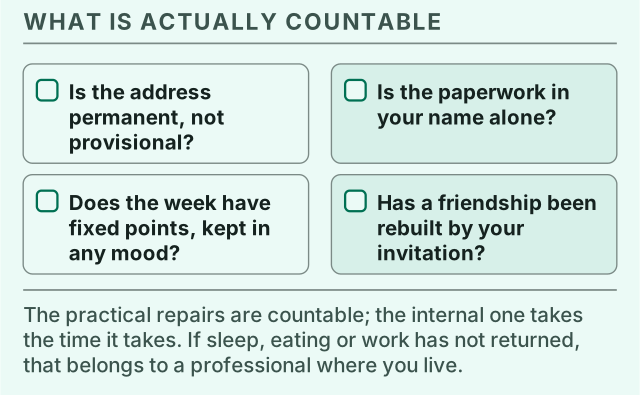
Measure the practical repairs, which are finite and countable, and let the internal one take the time it takes. Stop measuring in months: the unit is wrong and the benchmark is fictional.
If you want checkpoints that are not invented, use plain ones such as these: is the address permanent, is the paperwork in one name, does the week have two fixed points in it, and has one friendship been rebuilt by your invitation rather than someone else’s. Four yeses is a substantially better indicator than any month count, and it is one you can actually act on.
And if function has not returned — sleep, eating, the ability to work — that is not a timing question at all. It belongs to a doctor or a qualified professional where you live, and it does not require anything to have got bad enough first.
Where to go next
Starting over after divorce is the section this belongs to, and coping with divorce covers the same first year practically — the week, the anger, and where a professional belongs.
If the question underneath this one is really about timing the next relationship, how long to wait to date after divorce takes that interval apart on the same terms. And if this is happening in a specific decade, divorce after 40 and divorce at 60 set out what changes with age.
Also asked
How long does it take to get over a divorce?
Nobody can tell you, and the sources that do are quoting each other rather than data. No figure this site was able to trace measures recovery time after a divorce, so none appears here. What is describable is the sequence — sleeping and eating first, competence at ordinary tasks next, and interest in the future last — and that sequence runs at very different speeds for different people.
Why does everyone quote eighteen months or two years?
Because those numbers are comforting to give and impossible to check. Followed back, they lead to other articles, to a coach's rule of thumb, or to a study about something else entirely. A number attached to grief performs a real service — it implies an end — but an invented one leaves you measuring yourself against a milestone nobody built.
What does getting over a divorce actually involve?
Three separate repairs that people run together and then feel behind on. Practical reconstruction: address, money, paperwork, a week with a shape. Social reconstruction: friendships that were held jointly and now are not. And the internal part, which is the slowest and the least responsive to effort. They do not finish in the same year.
Is it normal to still be struggling after a year?
Yes, and the fact that a year feels like a deadline is a consequence of those circulating numbers rather than of anything measured. What matters more than elapsed time is whether the direction is right and whether the practical repairs have been made — people who are still living somewhere provisional, or whose finances are unresolved, are usually not stuck emotionally so much as stuck administratively.
Does it take longer if you did not want the divorce?
People describe it that way consistently, and the reason they give is that the decision arrived without them — there was no period of deciding, so the whole of the adjustment happens after the fact rather than partly before it. No verified figure compares the two, and this site will not supply one. What is worth saying is that a slower start is not the same thing as a worse outcome.
When should a professional be involved?
This site gives no clinical guidance and cannot assess anyone. What it will say is that the decision does not require a threshold to be crossed — nobody needs to be in a bad enough state to qualify. If sleep, eating or the ability to work have not returned, or the direction has been downward for a sustained period, that is a conversation for a doctor or a qualified professional where you live rather than for a website.