

Divorce after 40 is the end of a marriage in the middle of everything else rather than at the end of it, and that placement is what makes the decade its own problem.
Divorce after 40 gets written about as a softer version of divorce after 50 and a harder version of divorce at 30, and it is neither. It is a distinct problem, and the thing that makes it distinct is that almost nothing in your life is finished yet.
The finances are half-built. The career is mid-flight. The children, if there are children, are still at home and still watching. And unlike at 60, there is real time on the other side — two or three decades of it — which changes what every decision is worth.
What is actually different about divorce in this decade?
The differences are structural rather than emotional: money that is still under construction, two households on one budget, children who are still in the house, and a career that has not peaked.
Money that is under construction. At 60 the financial picture is largely made and the question is how to divide it. At 40 it is half-made, and the division happens to something that was supposed to keep growing. Retirement provision, equity, the years of earning that were planned around two incomes — all of it is being split mid-build. That is a different exercise from splitting a finished one, and it has a different set of professionals attached to it.
Two households on one budget means that a settlement does not halve the outgoings; it duplicates most of them. This is the cost people most consistently underestimate. Rent or mortgage twice, utilities twice, a second set of everything a child needs — a bed and a school bag in both houses, for example. It lands immediately, in the first month, while every other repair takes years.
Children who are present. Not adults who can be told the summary, and not infants who will not remember. School-age and teenage children are in the house, forming a view, and are frequently the most observant people in the building.
A career that has not peaked. At 40 the working years remaining are the asset. They are also the thing most likely to be sacrificed in the first year, because a divorce consumes attention in exactly the quantity that a job does.
What compensates for it?
Time. That is the whole of it, and it is worth more than it sounds.
A financial hit absorbed over twenty-five working years is a different object from the same hit absorbed over five. A social circle rebuilt at 42 has decades to become old friendships. A second long relationship, if you want one, has room to be long.
None of that makes the first year lighter. It changes what the first year is for: at this age it is genuinely a rebuild rather than a rearrangement, and the things you set up now are the things you will actually be living in.
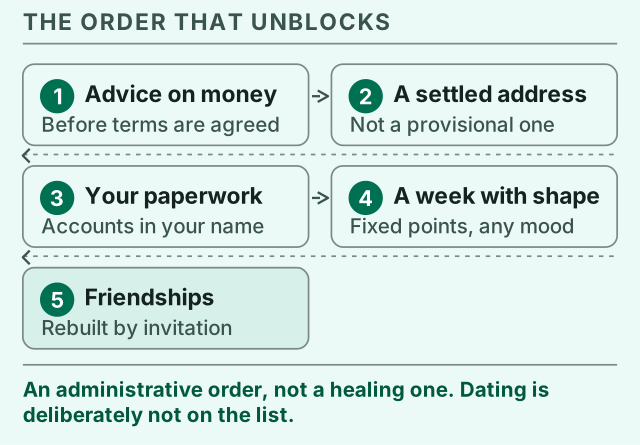
What order should any of this be done in?
Money first, then an address, then the paperwork, then a week with a shape, then friendships. The administrative repair is the forms, the addresses and the account names rather than the feelings, and it is what actually blocks everything else — which is why the sequence below is an administrative one rather than a healing one.
- Professional advice on the money, early. Advice is cheap before terms are agreed and expensive afterwards. The most common regret described by people who divorced in this decade is not the divorce; it is having accepted terms while exhausted to make the conflict stop.
- A settled address rather than a provisional one. Everything stays temporary until this is not.
- Your own paperwork. Accounts, insurance, documents, passwords, beneficiaries, in your own name. It is dull and it is the thing that keeps surfacing at bad moments if it is left.
- Two fixed points in the week. One weekday, one weekend, kept regardless of mood. This is the smallest structure that reliably stops a week from disappearing.
- Two friendships rebuilt by invitation rather than by waiting to be invited.
Dating is not on that list and that is not a moral position. It is that the list gets much easier to finish first, and dating done instead of it tends to be dating done for the wrong reason. How long to wait to date after divorce takes the interval apart properly.
What about the children is actually yours to decide?
What they are told and by whom is yours; the arrangements are not. Arrangements for children — who they live with, when, and what anybody is required to do — are decided under rules that vary by jurisdiction and by circumstance. This site states none of them. Your own lawyer answers that, and the answer is worth having before positions harden.
What is not legal, and is therefore genuinely yours to decide: how much they are told and by whom, whether they are ever asked to carry information between two houses, and whether either parent recruits them as an audience. Children at this age are old enough to be recruited and old enough to notice they have been. Consider the ordinary version: a message passed to the other parent through a child because it is easier than a phone call.
The other thing worth saying plainly: at 40 the children’s timeline and yours are different lengths. You are rebuilding for twenty-five years. They are getting through a school term.
What makes dating harder in this decade?
Two things, and neither is about desirability: the calendar, and the fact that everyone you meet arrives with a history as long as yours.
The calendar is the first. The calendar problem is the constraint people describe far more often than anything about the pool: between work, children and a household run single-handedly, the available hours are few and awkwardly placed. Imagine an evening that comes free at short notice in a week when the children are with their other parent — that is what a lot of dating in this decade gets timed around.
The second is that everyone arrives with a history of comparable length. Nobody in their forties is uncomplicated, including you. That cuts both ways: the conversations are more direct and there is less patience for pretending, but there are also two sets of obligations to fit together rather than one.
No verified figure describes any of this — not how long people wait, not how it goes, not how often it works. Any percentage offered for dating after divorce is invented; the ones checked for this site traced back to other articles rather than to data.
What the figures do and do not say
Two verified numbers are relevant here, and both need their population stated to mean anything.
Pew Research Center reports 14.4 divorces per 1,000 married women in the United States in 2023, down from a peak of 22.6 around 1980. That is a rate per 1,000 married women, not per head of population, and its direction is the useful part: divorce is becoming less common, not more. That direction is set out in Pew Research Center’s facts about divorce in the United States, which is the publisher’s own summary rather than a retelling.
And on how common it is to have been through one at all: Pew Research Center found that in 2023, one-third of Americans who had ever been married said their first marriage ended in divorce. One-third of the ever-married — not half of all marriages, which is folklore with no primary source behind it.
What no verified figure covers: any rate specific to people in their forties, which age is hardest, or what proportion of people describe the decade afterwards as good. The one age-band figure this site holds is about the over-fifties and is set out on divorce statistics by age, alongside what the denominators actually mean. Every figure the site stands behind, and every claim rejected, is on the numbers page.
One more, because people ask what happens next: Pew Research Center reports that about two-thirds of Americans who have divorced have gone on to remarry. That is cumulative across a lifetime and across every age, so it forecasts nothing about you — but it settles whether re-partnering after a divorce is a normal outcome. It is.
Where to go next
Divorce after 50 is the section this belongs to, and divorce at 60 is the same problem with the arithmetic reversed — less time to rebuild, but a finished financial picture and grown children.
For the first year without the age-specific parts, coping with divorce is the general version, and starting over after divorce covers what the rebuild consists of.
Also asked
How do you survive a divorce at 40?
In the order the costs arrive rather than the order the feelings do. Housing and income first, because everything else stays provisional until an address is settled. Then paperwork in your own name. Then two fixed points in the week that you keep whatever your mood is. Nothing on that list is inspiring, and people who came out the other side describe it as roughly what happened.
Is starting over after divorce at 40 realistic?
Realistic, yes; quick, no. Forty is early enough that most of the structural repairs — earnings, housing, savings, a social life that is yours — have time to work, which is not true in the same way twenty years later. What is not realistic is the version where the rebuild is emotional only. Most of the first two years is administrative, and people underestimate that consistently.
How do you date after divorce at 40?
Mostly the way anyone dates after a divorce, with two complications specific to the decade: the calendar is genuinely full, and the people you meet arrive with histories as long as yours. No verified figure describes how long anyone waits or how it goes, and any percentage offered for it is invented. The one thing worth settling first is whether you want company or want a household, because those lead to different decisions.
Is divorcing at 40 common?
Common enough that it is not remarkable, though no verified figure breaks divorce down by that single age. What is verified is the direction: Pew Research Center reports 14.4 divorces per 1,000 married women in the United States in 2023, down from a peak of 22.6 around 1980. Divorce is becoming less common overall, not more — which says nothing about whether yours was unusual.
How long does it take to feel normal again after divorcing at 40?
There is no reliable interval, and the figures in circulation for this — eighteen months, two years, half the length of the marriage — trace back to other articles rather than to data. What can be said is the order things return in: sleep and appetite before mood, competence before confidence, and ordinary weekday evenings long before anything that feels like happiness.
What about the children?
Arrangements for children are decided under rules that differ by jurisdiction and by circumstance, and this site states none of them — that is a question for your own lawyer, asked early. What is not legal, and is therefore yours, is how much your children are told, how often they are asked to carry a message, and whether they end up as anyone's confidant. That part is the one people most often say they would do differently.