
Most of what is written about women life after divorce is written about the feeling. The feeling is real, and it is not what the first year is mostly made of. The first year is made of a lease, a bank, a school run and a Tuesday evening that has to be got through — and the consistent report from people who are through it is that the feeling moved when those did.
Women life after divorce is a household problem before it is an emotional one, at least in that first year: who lives where, what it costs, whose name is on it, and who is doing the school run on a Thursday.
What changes first after a divorce?
The household. Not the identity, not the future, the household. Who lives where, what it costs, whose name is on it, and how the week is divided if there are children. Practical things, such as whose name the utilities are in and who is holding the spare car keys.
This is worth saying because the advice aimed at women after a divorce skews heavily towards the interior — the self, the healing, the person you are becoming — and skips the part that is actually consuming the hours. Both things are happening. Only one of them responds to being organised.
Who answers the money questions?
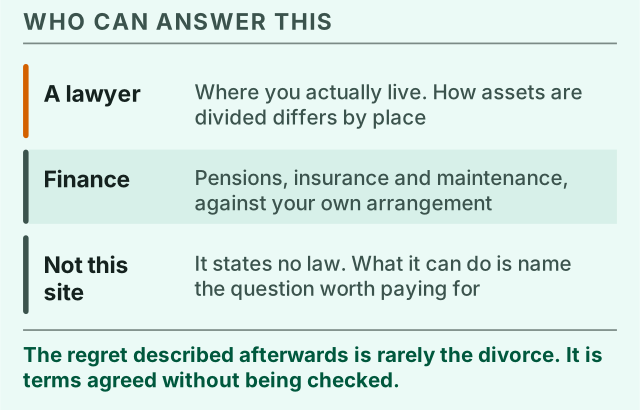
A lawyer and a financial professional in the place where you actually live, and nobody on the internet — including this site.
If the marriage involved an unequal split of earning — one career paused, reduced or never started because somebody had to be at home — then the financial questions are not a footnote to the divorce. They are the divorce.
What those questions have in common is that none of them have general answers. How the household assets are divided, how a paused career is treated, what maintenance looks like, what happens to pensions and to insurance: every one of those depends on where you live and on the specifics of your arrangement. A lawyer and a financial professional in your own jurisdiction are the only people who can answer them, and the most common regret described afterwards is not the divorce but agreeing to terms that had not been written down and checked.
This site gives no legal or financial advice, deliberately. The value it can add is telling you which questions are worth paying somebody to answer, and this is the biggest one.
What is different if you were the one at home?
The specific position — a stay-at-home mother getting divorced — carries two costs that are usually discussed separately and arrive together.
The first is financial and is dealt with above. The second is that the job description disappears at the same moment as the marriage. The role was real work, and much of it was invisible to everybody including, often, the person doing it. A double subtraction is losing the marriage and losing the structure of the day in the same month, and people who describe the first year as disorienting rather than merely sad are usually describing that.
The practical response is unromantic: rebuild the structure before rebuilding the identity. A week with fixed points in it does more for the second than any amount of thinking about it.
What happens to your friendships after a divorce?
Friendships formed as a couple do not divide neatly and frequently do not divide at all. They thin, on both sides, without anybody making a decision. The social bill is that quiet thinning — the friendships that turn out to have belonged to the marriage rather than to you.
Women describe this more often as the surprise of the year than the loneliness itself. Some of it is discomfort rather than judgement — a circle built around pairs has no obvious slot for one person, and most people are much worse at inviting a single friend than they believe. Consider the couple you used to see most: the invitations do not stop because anybody decided anything, they stop because nobody knows who is supposed to send them now. The move that works is being the one who invites, which converts a slow drift into a short and honest list of who actually turns up.
How much should you tell your children?
Less than the pressure to explain yourself suggests, and much less than an older child will ask for. The pressure to explain yourself to your own children is enormous, and it increases with their age. Older children in particular get offered more information than they wanted and end up holding opinions about one parent that they did not ask for.
The one thing worth refusing is the role of confidant. The role of confidant is the one where a child becomes the person you talk to about the divorce — for instance, the teenager who is told why the settlement is unfair because there is nobody else awake to tell. It is offered from both directions — sometimes by the child — and it is the version of the arrangement that is hardest to undo later.
What the figures say, and where they stop
Two verified figures are worth keeping, and both work as correctives rather than forecasts.
Pew Research Center found that in 2023, one-third of Americans who had ever been married said their first marriage ended in divorce. That is the number to hold onto instead of the “half of all marriages” line, which no primary source states and which this site treats as folklore.
And on what comes next: Pew Research Center found 68% of divorced men and 64% of divorced women have remarried. A gap, and a narrow one — narrow enough that the story about divorced women being structurally left behind is not what the data shows.
The long-run pattern behind that gap is documented separately: the National Center for Family & Marriage Research’s account of the retreat from remarriage describes remarriage becoming much less common since the middle of the last century, with men’s rate consistently running above women’s. If you want the official marital-history data rather than a summary of it, the Census Bureau’s report on the number, timing and duration of marriages and divorces is where that lives.
Both figures describe large numbers of other people. Neither can tell you anything at all about your own year. Every figure this site uses, with its population, its publisher and the date the link was last checked, is on the numbers page, and the age breakdown sits in divorce statistics by age.
The first year, in order
- A settled address, not a temporary one. Everything else is provisional until this is.
- Professional advice on the money, before terms harden rather than after.
- Your own paperwork — accounts, documents, insurance, passwords — in your own name.
- Two fixed points in the week, one weekday, one weekend.
- Two friendships rebuilt deliberately, by invitation rather than by waiting.
Dating is not on that list, and it is not a moral point. It is that the list gets much easier to do first, and dating done in place of it tends to be dating done for the wrong reason.
Related reading
Starting over after divorce covers the same first year without the gendered part. If the marriage was a long one and you are over fifty, divorce after 50 covers what changes structurally at that age. And when timing becomes the question, how long to wait to date after divorce is the honest version of the answer.
Also asked
How long does it take to heal from a divorce?
There is no verified average and this site will not print one. What people describe is improvement in uneven steps tied to concrete changes — a settled address, a rebuilt week, a friendship that came back — rather than a gradient that runs down over a fixed number of months.
What happens to women after a divorce?
In the first year: a change of address, an income that has to cover a household it was not sized for, a social circle that thins, and a week with holes in it. Afterwards, the reported pattern is wide — some describe the period as the worst of their lives and some as the point their life became legible, and a great many describe both.
Do women file for divorce more often than men?
The claim that women initiate most divorces circulates constantly, usually attached to a precise-sounding share. We could not trace that share to a primary source we were able to read, so this site does not print it. The underlying direction is widely reported; the exact number should not be quoted as fact.
Do divorced women remarry?
Most do, and the gap between the sexes is smaller than the folklore suggests. Pew Research Center found 68% of divorced men and 64% of divorced women have remarried — close enough that the story about women being left behind is not what the figures show.
What if I gave up my career for the household?
Then the financial questions are the important ones and they are not general questions. What you are owed, what the household assets are, and how a career interruption is treated all depend on your jurisdiction and your specific circumstances, and belong with a lawyer and a financial professional where you live — early, before terms are agreed.