

Dating a divorced dad gets written about as a series of hazards, and that framing is wrong from the first line. A man with children is not carrying an obstacle around. He has obligations that predate you, are not negotiable, and are the same obligations that would make him worth knowing in any other context.
Dating a divorced dad means dating a man whose week was allocated before you arrived and whose obligations are not yours to rearrange. What is genuinely different is practical: the timing, the amount of planning ordinary things need, and how much of the future can honestly be discussed in the first few months. Those are worth understanding early, because most of the trouble in this situation comes from expecting the rhythm of a relationship without them.
Why is the calendar the real subject, rather than the children?
Because the calendar is the part of his life you will actually meet. Planned time is time that has to be agreed in advance rather than found on the day, and almost all of his is planned.
A free evening exists or it does not, weeks in advance, and the answer is frequently outside his control. Plans change at short notice because something on the other side of the arrangement changed, and that will happen repeatedly. Consider an ordinary Thursday agreed a fortnight ago that dissolves on the Wednesday because something shifted at the other end — that is the mechanism, not a slight.
Two things follow, and they are worth separating.
The first is that spontaneity is largely gone, and people underestimate how much of early dating runs on it — the unplanned second drink, the weekend that extends itself. Losing that is a real loss and it is nobody’s fault.
The second is that scarcity distorts judgement. Time that is hard to get feels more valuable than it is, and intensity substitutes for frequency. Relationships built on rationed evenings can be six months old and still have almost no ordinary hours in them, which is where most of the misreading happens. For instance, a couple can be well past the early stage and still have never spent a dull Sunday together.
What is his pace telling you?
His pace is telling you which of two opposite things is going on, and from the outside they can look much the same.
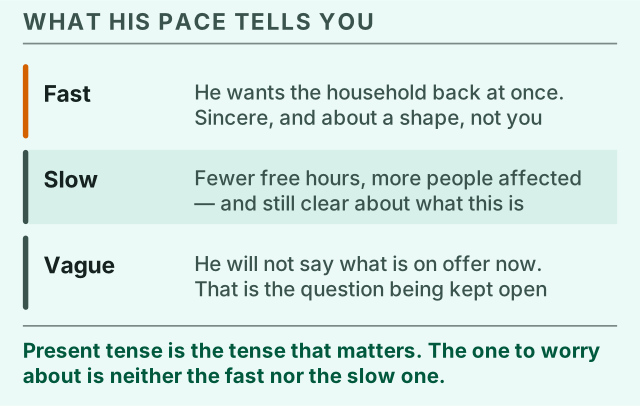
Fast. Some men come out of a marriage and want the structure back immediately: the household, the routine, the person at the table. That is a sincere want and it is about a shape rather than about you. Imagine being handed a key early on: warm, sincere, and still about a shape rather than about you. It moves quickly, it is flattering, and it is the version most likely to be discovered later to have been about the vacancy.
Slow and specific. Others move carefully, at a pace that has less to do with feeling than with arithmetic — he has fewer free hours and more people affected by his decisions. That reads as reluctance and frequently is not. The useful test is whether the slowness is consistent — a man who is careful about time and clear about intent is a different proposition from one who is slow about everything, including saying what this is.
The one that is worth worrying about is neither, it is vague. A man who will not describe what he is offering right now is not being careful; he is keeping the question open. Present tense is the tense that matters, because the future tense is being written by somebody whose future still has other people in it.
What is his to decide, and what is not?
The arrangements around his children are his and the other parent’s to decide; whether the arrangement works for you is yours, and the two lists do not overlap.
The parenting arrangement is the set of decisions about where his children are, when, and what each parent is required to do — settled between him, the other parent and, where relevant, the law. It is not a subject this site advises on, it is not yours to optimise, and any page that offers you tactics for that part is doing you no favours.
What is yours: whether the arrangement as it exists works for you. How much notice you need to feel like a person rather than a slot. Whether you want to be in a household with children in it at some point, or do not, which is an entirely legitimate answer and much better said early than discovered at month eighteen.
If a household with children in it is the direction you want, the research is thinner than you would expect. A peer-reviewed study of stepfathers who actively worked at building the relationship found that this effort was associated with a better stepparent-child relationship. It examined stepfathers rather than stepmothers, so read it as a description of what has been studied and draw the parallel yourself.
Most of the resentment in these relationships comes from someone working on the wrong list.
Is it a warning sign that his ex is still in his life?
No — where there are children, the other parent is part of his life indefinitely, and that is the arrangement working as intended rather than failing. Co-parenting contact is the running exchange between parents about their children: schedules, handovers, illnesses, school. It continues, and there will be conversations you are not part of.
The thing worth listening to is not whether he speaks to her but how — whether it is functional and brief, or whether the argument is still live and being conducted through the logistics. The second one consumes an enormous amount of attention, and it is attention that is not available elsewhere.
Equally, a man who describes the entire marriage as something that happened to him is telling you something. Nobody is purely a bystander in their own marriage, and a version with no responsibility in it usually means the accounting has not been done yet.
The expectations worth settling early
Four, and none require anybody to make a promise:
- How much time actually exists, described in a normal week rather than a good one.
- Whether you are a fact or something being managed, and what would change that.
- What you each want in five years — not as a plan, as a direction. Household or company, more children or none, one home or two.
- What happens when plans change, because they will, and the pattern matters more than any individual cancellation.
None of those are ultimatums. They are the difference between choosing this arrangement and defaulting into it and finding out later what it was.
What the figures do and do not say
No verified figure describes any of this directly — not how single parents date, not how these relationships turn out, not how long anyone waits. Every number offered for dating after divorce was checked for this site and none survived; they trace to other articles rather than to data.
What is verified is what happens after a divorce in general. Pew Research Center’s summary of divorce in the United States reports that about two-thirds of Americans who have divorced have gone on to remarry — cumulative over a lifetime, not a rate and not a forecast for anyone in particular.
And on the folklore that divorced men remarry while divorced women do not: Pew Research Center found 68% of divorced men and 64% of divorced women have remarried. The gap exists and it is much smaller than the stories suggest. Every figure this site stands behind, and every claim rejected, is on the numbers page.
Where to go next
What it means when he is divorced is the section this belongs to, and dating a divorced man covers the general version — pace, the ex, the questions worth asking out loud.
For the other side of the same situation, dating a divorced woman sets out what tends to differ. And if the divorce is not final yet, that is a different arrangement entirely: dating a separated man and dating during divorce cover it.
Also asked
How do you have a relationship with a divorced dad?
Largely the way you have any relationship, with two adjustments. Time is planned rather than spontaneous, so a fortnight's notice becomes normal and last-minute changes are a feature of the arrangement rather than a slight. And the future gets discussed later, because parts of it are not his alone to decide. Neither adjustment is a compromise on the relationship itself.
What are some signs that a divorced man is not ready to date?
The reliable ones are about the present rather than the past. He cannot describe what he is offering now without the description changing when he is anxious. Every conversation routes back to the marriage. Or the pace is enormous — three weeks in and the whole future is being planned. Intensity is the most misread signal here: it feels like readiness and is at least as often the opposite.
What are some red flags when dating a divorced man?
Two are worth more than the rest. Vagueness that never resolves — about what he wants, about where this is going, about whether you exist to the people in his life. And a version of events in which he had no part at all; nobody is entirely a bystander in their own marriage, and a story with no responsibility in it usually means the reckoning has not happened yet.
What are some signs a divorced man is ready to marry again?
The unglamorous ones. He talks about the marriage without heat and without a case to make. He can name what he would do differently and it is specific. And he makes plans at a range that requires actual commitment rather than enthusiasm. No verified figure describes how many remarry or when — what is verified is that most do at some point, which is not the same as being ready now.
Should I meet his children?
That is not a decision this site can weigh in on, and anything about arrangements involving children belongs to him and to the other parent. What is yours to decide is whether you want to be in that position at all, and when — and the honest answer is that meeting is a decision with consequences for people who did not choose any of this, so it is not one to arrive at by drift.
Will I always come second?
The framing is worth examining before the question is. A parent's obligations are not a ranking of the people they love, and treating them as a competition is a fight nobody can win. What is a real question: whether what is left over is enough for you, and whether he is honest about what that is rather than promising a version that does not exist yet.