

Dating a separated man is not a smaller version of dating a divorced one. He is still married. Dating a separated man means dating a man whose marriage has not ended, only changed shape. That is the whole of the difference and it is bigger than it sounds, because almost every assumption people bring to this situation quietly treats a separation as a divorce with slower paperwork.
Sometimes it is. Sometimes it is a marriage in an unresolved phase. From the outside, in the first few months, those two look identical — and the man in the middle of it frequently cannot tell you which he is in either.
What does “separated” actually mean?
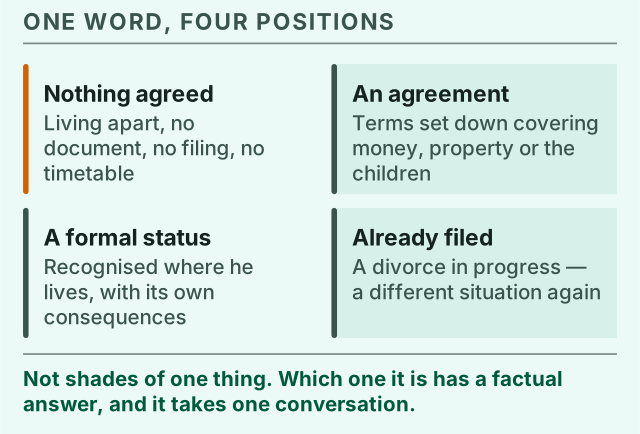
It covers several different arrangements, and the word conceals almost all of the difference between them. Separation is a single label stretched over positions that have little in common beyond a couple no longer living as one. What it can mean:
- Living apart, nothing agreed. No document, no filing, no timetable. The most common and the least settled.
- Living apart with a written agreement covering money, property or arrangements for children.
- A formal status recognised where they live, with its own requirements and its own consequences.
- A divorce already filed and in progress, which is a different situation again and is covered on dating during divorce.
Some couples are also still living in the same house while calling it separated, which is its own arrangement with its own problems.
These are not shades of one thing. They differ in what has been decided, what can still change, and what anyone is exposed to. The good news is that the question “which of these is it?” has a factual answer and takes one conversation.
Why won’t this site tell you what separation means legally?
Because those answers differ by jurisdiction and by circumstance, and a website that generalises here is guessing with somebody else’s exposure. Not because the questions are unanswerable — they have precise answers.
So you will not find here what separation means legally where he is, whether it affects his divorce, his money, his property or anything to do with children, or whether it touches you at all. This site states no law and will not tell you what usually happens, because “usually” reads as reassurance while committing to nothing.
Two lawyers matter here, and people only ever think of the first. His lawyer can tell him whether a new relationship has any bearing on his case. A lawyer where you live can tell you whether anything about the arrangement — shared spending, living together, being named in anything — has consequences for you. That second question is the one that goes unasked for years.
Both are short conversations and both are cheaper before anything is agreed than after.
The categories worth knowing exist
You cannot resolve these yourself, but knowing they exist is what turns a vague unease into a question you can actually put to someone qualified:
- Grounds and conduct. Whether a new relationship is relevant to how the divorce proceeds.
- Money. What is shared, what is still joint, and whether spending involving another person can be raised.
- Arrangements for children. Decided under rules that vary, and never something this site comments on.
- The temperature of the negotiation. Not a legal category at all, but the one most likely to bite. A quiet settlement can stop being quiet.
Anything on that list that is currently unresolved is a thing that can still move — the house, for example — and things that can still move change what he is able to offer you.
What does the asymmetry do to you?
It shrinks your own requirements until you stop stating them. The asymmetry is the gap between the size of what he is living through and the size of what you are, and this is the part with no legal component and the most damage in it.
He is in the middle of the largest disruption of his adult life. You are in an ordinary period of yours. Everything gets weighed on that scale, and the result is that your requirements start to look small next to his. Consider the ordinary version of it: you want to be introduced to a friend, he is negotiating over a house.
So you defer. Reasonably at first, then habitually. Six months of that produces a relationship with only one person’s needs in it, and it hardens long before either of you notices it was supposed to be temporary. The resentment shows up about a year after the sympathy did.
The correction is not to become demanding. It is to keep stating your terms at normal volume even when they sound trivial against his situation, and to notice if you have stopped.
Is it reasonable to be asked to keep it quiet?
Yes, as long as the request has an end date on it. There are real reasons for discretion, such as a case in progress, children who have not been told, or a lawyer who advised it.
Being asked is not the problem. Discretion with no end date is an arrangement rather than a precaution, which is the whole of the difference. The test is simple: discreet until what? An answer that names an event — a hearing, a settlement, a conversation with his children — is a different kind of answer from one that names a feeling.
If the honest version is that you are not to exist until further notice, then the position you are in is not the one that was described to you. Better to know that in month two than in year two.
Do separations always end in divorce?
No. Some end in divorce, some end with the couple back together, and some go on for years without ending at all, and raising that is not an insult.
No verified figure measures how often each happens — reconciliation after separation is not tracked in any source this site was able to read, so no percentage appears here. What that absence means practically is that you should treat his separation as unresolved until it is resolved, regardless of how settled he sounds. He is not lying when he tells you it is over. He is reporting on a situation that is still capable of moving.
What the figures do and do not say
Nothing measures this situation directly: not how long separations last, not how often they end in divorce, not how relationships that begin during one turn out. Any percentage offered for those is invented.
What is verified is the background. Pew Research Center reports 14.4 divorces per 1,000 married women in the United States in 2023, down from a peak of 22.6 around 1980 — divorce is becoming less common, not more. And Pew Research Center found that in 2023, one-third of Americans who had ever been married said their first marriage ended in divorce, which is considerably lower than the unsourced “half of all marriages” line. Every figure this site stands behind, and every claim rejected, is on the numbers page. If you want to read the underlying demographic research yourself, the Family Profiles series from the National Center for Family & Marriage Research is where much of it is published.
Where to go next
Dating someone going through a divorce is the section this belongs to, and dating during divorce sets out the categories of consequence and the exact questions to put to a lawyer.
If the feelings have moved faster than the paperwork, falling in love with a man going through divorce is about telling the real thing from the relief of being seen. And once a decree exists the calculation changes entirely — dating a divorced man covers that version.
Also asked
What does it mean when a man is separated but not divorced?
It means he is still married and something has changed about how the marriage is being lived. Beyond that the word covers very different situations: a couple living apart with nothing written down, a couple living apart with a written agreement, a formal status recognised where they are, or a divorce already under way. Which of those applies matters, and it is a question with a specific answer he can give you.
Is dating a separated man the same as dating a divorced man?
No, and the difference is not only paperwork. A divorce that has concluded is a settled fact; a separation is a position that can still move in any direction, including back. The practical consequence is that plans made on the strength of it are being made on something provisional, however certain he sounds about it.
Can dating someone who is separated but not divorced cause legal problems?
It can, and whether it does in his case depends on the jurisdiction, on what the divorce is proceeding under and on what is actually in dispute. This site states no law and cannot assess a situation. His own lawyer can answer it quickly, and a lawyer where you live can tell you whether anything touches you — which is a separate question and the one people forget to ask.
How long do separations usually last before a divorce?
There is no verified figure for that, and any average offered for it is invented — the ones checked for this site traced back to other articles rather than to data. What can be said is that separations do not run on a standard clock, and the length of one already in progress is a better guide than any general number.
Should I wait for a separated man to finalise his divorce?
If you decide to, decide it properly: set an interval privately and be honest with yourself when it passes. Open-ended waiting is not patience, it is a decision repeatedly declined, and it has a habit of consuming a year nobody agreed to spend. The question is not whether he is worth waiting for. It is whether the arrangement you are in is one you would have accepted if it had been described plainly at the start.
What should I ask him before this gets serious?
Four things, and all four have factual answers: what kind of separation this is, whether a divorce has actually been filed, what is still unresolved, and whether you are a fact or a secret — and if a secret, until what event. A man who treats any of those as an accusation has answered it.