

Almost everybody searching for what dating during divorce does to their case is looking for permission or a prohibition, and the honest position is that this site can supply neither. What it can do is set out the categories of consequence that genuinely exist, say plainly which of them nobody can answer in general, and give you the questions that turn a vague anxiety into a ten-minute conversation with the person actually qualified to settle it.
Dating during divorce means seeing someone new while your marriage is still legally in place and the case is still open — which covers everything from before a filing to the weeks after an agreement is reached but before the decree exists.
What are the two questions hiding inside “can I date during my divorce”?
The first is legal and belongs to your lawyer; the second is everything a new relationship does to your children, your attention and the person you start seeing, and that one is yours. “Can I date during my divorce” collapses those two different problems.
The first is legal and financial: whether a new relationship has any bearing on how your case proceeds or ends. That has a real answer, it varies, and it is not ours.
The second is everything else: what it does to your children, to the person you start seeing, to your relationship with the other side, and to the attention you have left. That one is not legal at all, and it is the part almost nobody asks about until it has already happened.
Which areas can dating during divorce touch?
The grounds the divorce is proceeding under, the financial side, arrangements for children, and the temperature of the negotiation — those are the areas in which the question comes up. Naming them is not a claim that any of them applies to you — several will not, and which ones depends entirely on where and how your divorce is proceeding.
Grounds and allegations. How a divorce is filed, and on what basis, is not uniform. Whether a new relationship is relevant to that in your case is a question with a specific answer.
The financial side. Support, maintenance and how assets are divided are decided under rules that differ by place. Where money is spent, and who is living with whom, can become visible during the financial part of a case — bank records and household arrangements are ordinary material in a contested one.
Arrangements for children. This is the area people worry about most and understand least. What is considered, by whom, and on what basis varies widely, and the answer for your case is not the answer for the case your friend described.
The temperature of the negotiation refers to how willing the other side stays to keep settling things quietly. This one is not legal at all and is often the largest in practice. For example, a settlement that was proceeding quietly can stop proceeding quietly. That has a cost measured in months and in fees, whatever the underlying rules say.
Why won’t this site tell you what the law is?
Because divorce rules differ by jurisdiction and outcomes differ by case, and a website that has never seen your file, your grounds or your county is not in a position to tell you how any of it will land. Everyone who does it anyway is guessing on your behalf, at your expense.
So it will not tell you what the law is. Not in general terms, not with a qualifier, and not in the form of “usually” — which is the version that does the most damage, because it reads as reassurance while committing to nothing.
The useful thing an article can do is tell you which question to ask, and of whom.
What should you ask your own lawyer?
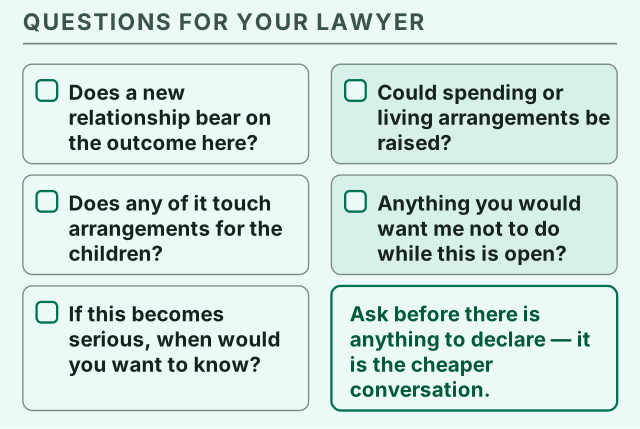
Ask whether a new relationship has any bearing on the grounds or the outcome here, whether spending or living arrangements involving another person could be raised, whether any of it touches the arrangements for the children, and whether there is anything they would want you to avoid while the case is open. It is one conversation, it is short, and people put it off because they expect to be told off. They almost never are. What to ask:
- Does a new relationship have any bearing on the grounds or the outcome in this case?
- Could spending, or living arrangements involving another person, be raised in the financial part?
- Does any of it touch the arrangements for the children?
- Is there anything you would want me not to do while this is open? — the most productive of the four, because it invites the specific rather than the general.
- If this becomes serious, when would you want to know?
Ask before there is anything to declare. A hypothetical question is cheap and unremarkable; the same question asked after the fact is a different conversation, and a more expensive one.
Does it matter where in the process you are?
Yes — a divorce is not one state, so an answer that fitted one stage was an answer about that stage. People ask this question once, get an answer, and treat it as settled for the duration. It is worth noticing that a divorce is not one state — before anything is filed, during the financial part, while arrangements for children are being worked out, after an agreement is reached but before it is approved, and after the decree are five different positions to be in.
Whether your situation changes as you move between them is exactly the kind of thing that varies by jurisdiction and by case, which is why the sensible move is to re-ask rather than to assume the first answer still holds. It costs a sentence in an email you were sending anyway.
The one distinction worth holding onto in the meantime is between the process being contested and the process being administrative. A contested divorce is one in which something substantive — the money, the arrangements for children — is still being argued over, and that is a different environment from one where nothing substantive is in dispute. People routinely apply advice from the first to a situation that is plainly the second.
The consequences nobody asks about
These are the ones this site can speak to honestly, because they are not legal and they are consistent.
Your children. They are already absorbing a change nobody consulted them on. A new person appearing inside that, before anything is settled, is a second change stacked on the first. Consider a child who is introduced to someone new while the household arrangements are still being worked out, and then does not see that person again. An introduction that comes late can be corrected. One that comes early and then ends cannot be un-had.
The person you are dating. They can consent to this situation, but only if they are told what it is. Being kept off the record, being briefed on what to say, being asked to be discreet with no end date attached — those are real costs, and they are usually described as protection.
Your attention. A divorce in progress is a second job with unpredictable hours. Let’s say a deadline from your lawyer lands in the same week as a weekend you had planned; the weekend is what moves. Something gets less than it needs, and it is rarely the case that gives way.
Your own account of it. People in the middle of a divorce tend to date in order to be believed. That is understandable and it is not a good basis, because the other person is being recruited as a witness rather than met as a person, and most people can feel that happening by the second drink.
If you are the one being dated
The same questions apply from the other side, minus the legal exposure, plus one addition: you are not the person whose case it is, so the risk is not symmetrical. Ask whether the divorce is a decision already made or one still being made. Ask whether your existence is a fact or a secret. Neither question is unreasonable, and both are answerable.
What the numbers do and do not say
Nothing measures this question. No verified figure exists for how often dating during a divorce changes an outcome, and any percentage offered for it is invented; the ones we checked traced back to other articles rather than to data.
What is verified is the background. Pew Research Center reports 14.4 divorces per 1,000 married women in the United States in 2023, down from a peak of 22.6 around 1980 — divorce is becoming less common, not more. The U.S. Census Bureau’s account of marriage and divorce describes the same direction of travel. And Pew Research Center found that in 2023, one-third of Americans who had ever been married said their first marriage ended in divorce, which is considerably lower than the unsourced “half of all marriages” line. Every figure this site stands behind, and the list of claims we rejected, is on the numbers page.
Where to go next
For the shape of the situation from the other side, dating someone going through a divorce covers what it costs the person who is not the one divorcing. Once the decree exists, the calculation changes — dating a divorced man and what it means when he is divorced cover that version.
If the question is really about your own timing rather than your case, how long to wait to date after divorce takes the interval apart, and divorced and dating is where it starts once the paperwork is done.
Also asked
Can you date while going through a divorce?
People do, constantly, and whether it carries a cost in your particular case is not something a website can answer. It turns on the jurisdiction, on the grounds the divorce is proceeding under and on what is actually in dispute. The only person who can tell you is the lawyer running your case, and it is a short question to ask.
Should you date while going through a divorce?
That is a separate question from whether you can, and it is the one you can answer yourself. It depends on how contested the process is, whether children are involved, how much attention you have left, and whether you would be able to tell the other person the truth about what they are joining. Where those answers are uncomfortable, waiting is cheap by comparison.
Is dating during a divorce considered adultery?
How adultery is defined, whether it still matters and what it would affect vary by jurisdiction, and this site does not state the law anywhere. It is a real question with a real answer for your case, and it belongs to your lawyer. Ask it plainly — it is a routine question and it will not surprise them.
Can dating during a divorce affect custody or support?
Arrangements for children and the financial side are the two areas people most often ask about, and both are decided under rules that differ by place and by circumstance. Whether a new relationship has any bearing on either in your case is a question for your own lawyer, ideally before anything is worth mentioning rather than after.
Can you date once you are separated but not divorced?
Separated is a different status from divorced, and what it means in practice depends on where you are and on any agreement already in place. The same rule applies: what it means for your case comes from your lawyer, and the non-legal costs — to children, to the person you are dating — are yours to weigh.
What should I ask a lawyer before dating during a divorce?
Four things: whether a new relationship has any bearing on the grounds or the outcome here; whether spending or living arrangements involving another person could be raised; whether it affects anything to do with the children; and whether there is anything they would want you to avoid doing while the case is open. Ask early — the answer is cheap before it is relevant and expensive after.