

The first relationship after divorce carries a load it was never designed for. It has to be a relationship, and at the same time it has to answer a set of questions that only stopped being theoretical when the marriage ended: what you actually want, who you are on your own, whether any of this still works.
The first relationship after divorce is the one that does the finding-out: the place where a theory about what you want next meets an actual person. Most of them end. That is not a warning and it is not a failure rate — it is the shape of the thing, and knowing the shape is what stops people concluding something false about themselves when it happens.
What is the first relationship after divorce actually for?
It is for finding out what you want now, and you cannot find that out by thinking about it. Preference in this area is discovered by contact, and it turns out to be surprisingly different from what you would have predicted while sitting alone with a notebook.
People come out of a marriage with a theory of what went wrong and a matching theory of what they need instead. The first relationship is where those theories meet a person. Some survive contact. Most get revised, and a few get discarded within a fortnight — the requirement you were certain about turns out to be a preference, and the thing you never thought to specify turns out to be non-negotiable. Let’s say you came out of the marriage certain you needed somebody who talks everything through; weeks later, what you cannot do without turns out to be somebody who is where they said they would be.
That is genuinely valuable information. It also cannot be obtained without involving someone who has their own stake in the outcome, which is the uncomfortable fact at the centre of this whole subject.
Why do so many of them end?
Because the questions get answered.
Once you know what you want, the relationship that taught you often turns out not to be it. There is no version of that which is painless for at least one person, and there is usually no villain in it either. Nobody misled anybody. The situation simply changed underneath both of them, because one of them was finding something out.
The second reason is quieter. The first relationship after a marriage tends to be measured against the marriage rather than against anything reasonable — either as a corrective (nothing like the last one, therefore good) or as a comparison (not like the last one, therefore lacking). Both are ways of not seeing the person in front of you, and both tend to collapse around the point the relationship stops being new.
How do you tell a rebound from a beginning?
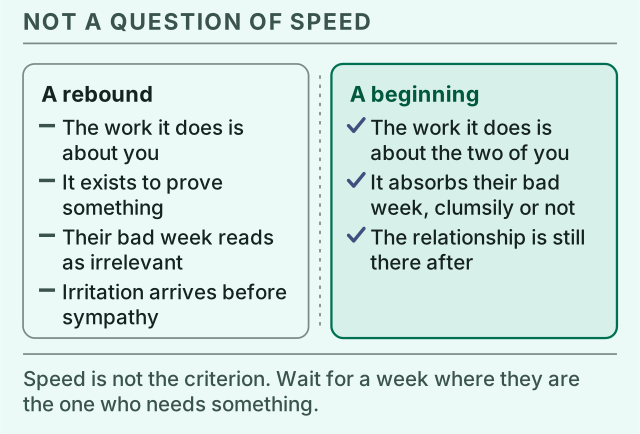
By what the relationship does when the other person is the one who needs something. The word itself is used badly. Speed is not the criterion — some rebounds start two years out and some serious relationships start in month four.
A rebound is a relationship doing work about you rather than about the two of you. It exists to prove something: that you are still wanted, that the marriage was the problem, that you can. The relationship is real, the feelings are usually real, and the job it is doing is still primarily internal.
The reliable test is a boring one. Wait for a week where the other person is the one who needs something — a bad week at work, a family problem, nothing to do with you at all. A beginning absorbs it, sometimes clumsily, and the relationship is still there afterwards. A rebound finds it faintly irrelevant, and the irritation shows up before the sympathy does.
Nobody enjoys running this test on themselves. It is still cheaper than the alternative, which is finding out in month nine.
What should you say, and when?
Say it early, briefly, and once.
“This is the first serious thing since my divorce” is a complete sentence and it does not need a paragraph after it. What it buys you is the correct reading of your pace. Caution that is explained reads as caution; caution that is not explained reads as indifference, and people respond to indifference by leaving or by working harder, neither of which you wanted.
What it is not is a permission slip. Saying it does not license doing whatever the next six months produce. It is a statement of where you are, not a waiver — and the difference matters, because the version where it gets deployed later as a defence is the version that leaves damage behind.
What if you are the person they are dating?
You are not a waiting room, and you are not obliged to be endlessly patient because you read an article explaining what they are going through.
Knowing the pattern is useful. Being required to absorb it is a different arrangement, and it is frequently offered warmly enough that it takes months to notice. The questions worth asking are not about their marriage. They are about your position: whether your existence is a fact or something being managed, whether the pace is slow or stalled, and whether you are being met or staffed. For example, whether you have met anybody else in their life, or are still being seen only on the evenings that were already free.
Ask them out loud. Somebody who treats a plain question about where this is going as an accusation has answered it.
Children, and the introduction that cannot be un-had
If there are children, the first relationship after a divorce is the one where the introduction question arrives with no precedent to draw on, and most people get the sequencing wrong in the same direction: too early, for a warm reason.
An introduction to your children is the one step in this that cannot be reversed, and that asymmetry is the thing to hold onto. An introduction that comes later than it needed to can be corrected in an afternoon. One that comes early and is followed by the relationship ending cannot be un-had — the children have now met and lost somebody, which is a second departure stacked on the first, and they had no say in either.
Given how many first relationships end, that is not a small consideration. It is the strongest practical argument for treating this particular relationship as provisional in one specific respect while treating it seriously in every other.
What that looks like in practice is unremarkable: the relationship gets to be real, adult and unhurried, and the children meet somebody when the answer to “is this a person who will still be here in six months” has stopped being a hope. Nobody can guarantee that answer. There is a large difference between not being able to guarantee it and not yet having any evidence. Consider the ordinary version of it: the children meet somebody who has already been around for months, at a park on a Saturday, with no announcement attached and nothing riding on how it goes.
The one thing worth refusing outright is the introduction made to force a decision — yours or theirs. It happens, usually framed as readiness, and children are not an instrument for settling an adult question.
What the figures do and do not say
Two verified figures, both useful for cutting the situation down to size.
Pew Research Center found that in 2023, one-third of Americans who had ever been married said their first marriage ended in divorce. That is the number to hold instead of the “half of all marriages” line, which no primary source states.
And on what tends to follow: Pew Research Center reports that about two-thirds of Americans who have divorced have gone on to remarry — a cumulative lifetime figure, not a schedule, and not a statement about the relationship you are currently in.
What no verified figure covers: how long first relationships after divorce last, what share of them end, or how they compare to anything. Those numbers are quoted constantly and none of them survived checking. Every figure this site stands behind, with its population and its publisher, is on the numbers page. The demographic work behind figures like these sits with Pew and with the Family Profiles series from the National Center for Family & Marriage Research, if you would rather read the source material than a summary of it.
Where to go next
Divorced and dating is the section this belongs to, and how long to wait to date after divorce covers the question that comes immediately before this one.
For what tends to happen after this relationship rather than during it, finding love after divorce is the longer view. If you are the one dating someone recently out of a marriage, dating a divorced man and dating a divorced woman are written from your side of it.
Also asked
Can the first relationship after divorce work?
Yes. It is not the common outcome, but plenty of long marriages began as somebody's first relationship after a previous one, and treating it as doomed from the start is its own way of ending it. What raises the odds is not intensity — it is whether both people are describing the same relationship out loud by about month three.
Why is the first relationship after divorce so hard?
Because it is doing two jobs at once. It has to be a relationship, and simultaneously it has to answer a set of questions that only stopped being theoretical when the marriage ended. Nobody has the bandwidth for both, so it gets done badly in one direction or the other, usually in the direction of the questions.
How long does the average first relationship last after divorce?
No verified figure measures this and none appears here. The durations quoted online trace back to other articles rather than to data. What is describable is the pattern people report: long enough to become serious, rarely long enough to become permanent, and often ending shortly after it stops being new.
Is it okay to start a relationship after a divorce?
Yes, and the more useful question is what you tell the other person. Starting is not the risky part. Starting while presenting yourself as further along than you are is the risky part, because it recruits somebody into a situation they were not given the chance to accept.
Is the first relationship after divorce always a rebound?
No, and the word is now used so loosely it has stopped meaning much. A rebound is specifically a relationship whose main job is to prove something to you about yourself. Plenty of first relationships are not that. The tell is not how soon it started — it is what happens when the other person needs something and there is nothing in it for you.
Should you tell them it is your first relationship since the divorce?
Yes: plainly, once, and early, without turning it into a warning label. It is a fact about your situation that changes how your pace should be read. Withholding it does not protect them — it just means your caution gets read as disinterest, which is the version that hurts.