

The question underneath finding love after divorce is rarely about probability. It is about whether the capacity survived — whether a person who has already done this once, at length and badly, can still do it. That is a different question, and it has a much better answer.
The capacity survives. Finding love after divorce is that same capacity used a second time, with a harder standard of proof attached. What changes is what you will accept as evidence, and that change is both the advantage and the trap.
What is actually different the second time?
The conversations are shorter and considerably more direct. Things that took six months to establish in a first relationship get established in one evening, because both people have already discovered what they cannot live with and have stopped apologising for knowing it.
The register is different too. People describe second relationships as quieter — less certainty in the first fortnight, more of it in the sixth month. That reads as a downgrade to anybody whose model of love is the first one they had. It is closer to the opposite: the intensity that goes missing was largely the intensity of not yet knowing.
And the requirements get shorter and firmer. First marriages tend to be entered with a long list of preferences and a vague set of limits. People come out of a divorce with the reverse — few stated preferences, two or three absolutes, usually phrased as things they will not do again.
Which habit does most of the damage?
Pattern-matching is the habit of filing a new person under a category built from your marriage, and it does more damage than anything else here. Experience hands you categories, and categories are efficient right up to the moment they start arriving before the evidence does.
It looks like discernment from the inside. Somebody is quiet on the phone, for instance, and you have already placed them; somebody is late twice and you have seen this film. Occasionally you are right. The problem is that the category was built from a sample size of one marriage, and it is being applied at week three, when the only thing you actually know is that they were quiet on the phone.
The workable test is procedural rather than emotional. When you catch yourself concluding, ask what specifically this person has done — not what it resembles. If the answer is thin, you are recognising your marriage rather than reading them.
The exception worth protecting: this does not apply to the things you decided you will not do again. Those are not pattern-matching. Terms are the specific things you decided you would not do again, and stating one is not a category you are applying to somebody — it is a condition you are naming.
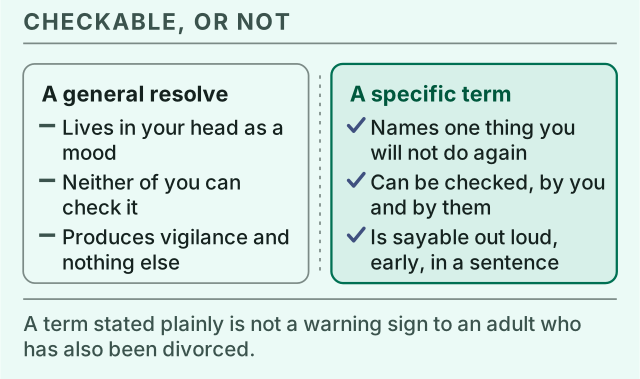
Why does the vague version of your terms fail?
Because a general resolve cannot be checked — not by you and not by the person you are seeing. The single most useful thing people report doing is converting general resolve into specific statements.
Consider the difference. “I will be more careful” is not usable. It cannot be checked and it produces nothing except vigilance. “I will not again be the only person who notices when something is wrong” is usable: you can tell within two months whether it is being met, and so can the other person.
The specific version has a second benefit that people rarely anticipate. It is sayable out loud. A list of absolutes stated plainly, early, is not a red flag to an adult who has also been divorced — it is the most efficient conversation available, and it sorts people faster than any amount of watching.
How much of the marriage should you tell, and when?
A short factual version, early, with no defence attached, and nothing more until it comes up on its own. The marriage will come up, and the two failure modes are equally common and equally self-inflicted.
The first is the full account, delivered early, usually in response to a mild question. It feels like honesty and it is closer to a deposition — the other person is being asked to evaluate a case rather than meet a person, and the effect is that they now know a great deal about somebody they will never meet and very little about you.
The second is conspicuous silence. A decade sealed off, deflected each time it approaches. That does not read as privacy. It reads as an active site, and it makes the subject louder than any amount of talking would have.
What works, by consistent report, is short. The short factual version is how long, roughly why, and that it is finished, with no defence attached. Two sentences. The point is not to satisfy curiosity but to establish that the subject is available and unarmed, which is what lets it come up naturally later, in pieces, at the pace it actually needs.
There is one useful test for whether you are ready to give the short version: can you say it without needing the other person to agree with you about it? If the answer is no, that is worth knowing, and it is not a verdict on the timing so much as information about it.
The people around you, and the second-time audience
Something that surprises people about a second serious relationship is how much of it is conducted in front of an audience that has opinions.
Friends who watched the marriage end frequently have a view about the next person, and they tend to express it as concern. Adult children have views and express them less. Parents, in some families, have the strongest view of all and the least information.
None of that is a reason to hide a relationship, and hiding one is how a manageable set of opinions becomes a grievance. What is worth doing is deciding in advance whose approval is actually load-bearing — usually a much shorter list than the one giving feedback — and declining to run the relationship as a consultation with everybody else.
What is the difference between wanting company and wanting this person?
They are different appetites and they are easy to confuse, especially in the first year, and especially in the evening.
The confusion is not shameful and it is not rare. It matters because the two produce identical behaviour for about eight weeks and then diverge sharply. A relationship built on the first appetite tends to be discovered when the loneliness lifts for an unrelated reason — a friendship coming back, a week that finally had a shape — and the relationship suddenly has to stand on its own.
The cheapest test is subtraction. Imagine the loneliness gone, everything else unchanged. If you would still be arranging to see this specific person on Thursday, that is a real answer. If the honest response is a shrug, that is also a real answer, and it is better to have it in week eight than in month eleven.
What the figures do and do not say
Two verified numbers, both from the same publisher and both useful mostly as correctives.
Pew Research Center reports that about two-thirds of Americans who have divorced have gone on to remarry. That is a cumulative lifetime figure rather than an annual rate, and it says nothing about when — but it does settle the question of whether this is a thing that happens to ordinary people. It is the usual outcome.
And on the folklore about men rushing back to the altar while women are left behind: Pew Research Center found 68% of divorced men and 64% of divorced women have remarried. A gap, and a narrow one. The longer-run picture from the National Center for Family & Marriage Research on the retreat from remarriage runs the same way — men’s remarriage rate has consistently sat above women’s, on an overall rate that has fallen a long way over the decades.
What no verified figure covers: how long it takes to meet someone, how well second relationships fare, or what proportion of people describe the second one as better. Those numbers get quoted with great confidence and none of them survived checking, so none appear here. Every figure this site stands behind, and the list of claims that were rejected, is on the numbers page.
A note on the search results
Searching this phrase turns up a South Korean reality series with the same name, which is why half the questions around it are about cast members and streaming. Worth saying plainly: this page is not about the programme, and a television format built for conflict is not evidence about anything.
Where to go next
Divorced and dating is the wider section, and how long to wait to date after divorce takes the timing question apart properly. The relationship that usually comes before this one has its own page: the first relationship after a divorce.
If you are meeting people online rather than through the thinned-out circle, dating apps for divorcees covers what is actually different about those platforms. And if the person you are seeing is the divorced one, dating a divorced man is written from that side.
Also asked
Is it possible to find true love after divorce?
Yes, and it is the ordinary outcome rather than the exceptional one. Pew Research Center reports that about two-thirds of Americans who have divorced have gone on to remarry, which is a statement about how usual it is rather than a promise about you. What that figure cannot tell you is when, or whether the relationships are good — no verified source measures either.
How long does it take to find love after divorce?
There is no verified figure and this site will not invent one. The spread people describe runs from months to many years and the variable that matters least is time elapsed. What consistently precedes it is a rebuilt week, a settled address and the ability to describe the marriage ending without needing the listener to take your side.
Is it harder to fall in love after divorce?
Harder logistically and easier substantively. The pool is smaller and more scattered, and everybody in it has a schedule already spoken for. What is easier is the talking: conversations that took six months the first time take one evening, because both people have already found out what they cannot live with and have stopped being embarrassed about saying so.
What is the 2 2 2 love rule?
A relationship-maintenance habit, not a piece of research: a date every two weeks, a night away every two months, a longer trip every two years. It has no evidence behind it and it is not a diagnosis of anything. What it is quietly good at is the thing second relationships most often lose — scheduled attention, in a life where both people's calendars were full before they met.
Is this page about the Netflix series Love After Divorce?
No. A South Korean reality series is also called Love After Divorce, and a lot of searches for this phrase are looking for it, its cast or where to watch it. This site does not cover television and cannot tell you which couples are still together. Everything here is about the actual thing.
How do you stop comparing a new partner to your ex?
You do not, entirely, and trying to is what makes it loud. Comparison is a problem when it is used as a verdict rather than as information. Noticing that this person handles conflict differently is useful; concluding within a fortnight that you already know how it ends is the pattern-matching that closes second starts early.