

The market for dating apps for divorcees is smaller and stranger than the search term suggests. The big names most people expect are general-purpose apps with divorced users on them rather than products built for the situation, and the sites that were built for it are small and regional in ways no review page mentions. That is the honest starting position, and it changes what a useful answer looks like. Dating apps for divorcees are less a single product category than a search term covering separate kinds of platform: general-purpose apps with divorced users on them, small divorce-specific sites, and age-targeted services.
What kinds of dating apps for divorcees actually exist?
They fall into a few recognisable groups: the large general-purpose apps, the small divorce-specific sites, and services aimed at an older age band.
The large general-purpose apps. You know the names. They are not divorce products; they are population products, and their advantage is straightforward — in most towns they are where the people are. Marital status is a field on a profile, nothing more.
Divorce-specific sites are platforms built for people out of a marriage rather than general apps with a marital-status field. Several of them exist, and they are much smaller than the general apps. The trade is real and it cuts both ways: everyone there has the same context and nobody has to explain it, but the pool in any given area may be thin enough that the advantage is theoretical. This is checkable in fifteen minutes with a free account, and it is the first thing to check.
Age-targeted services are aimed at the over-fifties rather than at divorced people specifically, though the overlap is heavy. If the marriage was long and the divorce late, these often behave more usefully than either of the other two.
This site has not tested any of them. That is a limitation, stated rather than concealed — the alternative is a ranking assembled from other people’s marketing copy, which is what most pages answering this question actually are.
What is a free account actually for?
A free account is a measuring instrument rather than a dating one: it exists to tell you whether there are people within reach before any money changes hands. Not for dating. For measuring.
Every category above lets you register, build a profile and look at who is within reach without paying anything. Do that on two or three before spending a penny, and answer one question: are there enough people here, in my area, in my age range, who were active this month?
If the answer is no, no subscription will change it. That is the single most common way money is wasted on this — buying visibility inside a pool that is empty. If the answer is yes, you now know which platform you are paying for and why, which is a much better position than the one most people pay from. Consider a divorce-specific site that returns almost nobody within travelling distance on a free account: that is an answer, and it cost nothing to get.
What should you ask before you pay?
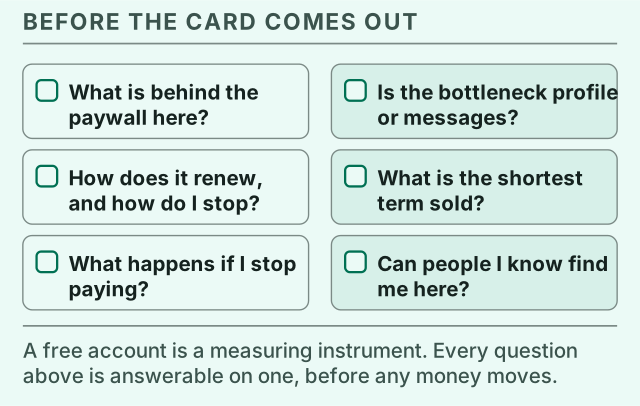
Ask what is actually behind the paywall, and what your own bottleneck is, before anything else. Six, in the order they matter:
- What specifically is behind the paywall? More matches, more messages, more visibility, or filters. These are different products and only one of them is your bottleneck.
- What is my actual bottleneck? No matches is a profile problem. Matches but no conversations is a message problem. Neither is solved by a subscription.
- How does it renew, and how do I stop it? Find the cancellation route before you subscribe, not after.
- What is the shortest term available? A month tells you almost everything a year does.
- What happens to my profile and my messages if I stop paying?
- Can I be found by people I know? Colleagues, in-laws, your children’s friends’ parents. Worth deciding deliberately rather than discovering.
What this site will not publish
No affiliate links. There is no arrangement with any platform here, and if one ever exists it will be stated on the page it appears on.
No pricing table. We have not verified the current price of a single service. A table of unchecked prices looks authoritative and goes stale within a quarter, and publishing one would be exactly the thing this site refuses to do with numbers everywhere else.
No ranking. A comparison worth reading is built from accounts actually opened and pools actually counted, city by city. An index along those lines is being compiled. It is not finished and we are not promising a date, because the useful version takes longer than the useless one.
Why do the search results look so strange?
Because nobody is optimising for the phrase, so what comes back is small divorce-specific sites and the pages ranking them rather than the names you expected. Worth knowing before you start clicking.
Type this question in and the big names do not come back. What surfaces instead is a set of small, divorce-specific sites and a lot of pages ranking them — pages that, on inspection, are mostly assembled from each other. The absence of the household-name apps from these results is not evidence that they are unsuitable; it means nobody is optimising for the phrase, which is a fact about search rather than about products.
The practical consequence is that a smaller operator deserves two extra checks before money changes hands. Is anyone actually active — profiles with recent activity, not just profiles. And is the site itself being maintained — signs such as a working contact route, terms you can read, a cancellation path that exists. Neither check takes long, and both are worth more than any ranking, including a future one of ours.
The routes that are not apps
Worth taking seriously, because the people who report the best experience after a divorce generally use both.
What works is anything with a reason to come back: a class that runs a term, a sport with fixtures, volunteering with a rota, a choir, a regular night. Repeated exposure produces information an app cannot — how somebody behaves when they are tired, whether they turn up. Imagine the same faces at the same Tuesday session for a whole term: by the end of it you know things no profile would have told you.
The slower route also solves the problem apps are worst at, which is scale without depth. Ten matches in a week is not ten opportunities. It is ten first conversations, and first conversations are the least informative part of meeting anybody.
What should your profile say about the divorce?
It should say it briefly and once: “Divorced” as a fact, no story attached, nothing defensive, and no reference to what she or he did. Anybody reading it has either been through one or knows several people who have; it is ordinary information and it stops being remarkable the moment you treat it as ordinary.
The version that costs you is the one that argues. A profile that explains, justifies or pre-empts is answering a question nobody asked yet, and it reads as a case still being made.
What the figures do and do not cover
No statistic about online dating, app usage or success rates is approved for use on this site. Those were checked specifically for this niche and nothing traced back to a source we could open and read, so no percentages appear on this page. That is unusual for a page about apps, and it is deliberate.
What is verified is the background. Pew Research Center, analysing 2023 data, reports that about two-thirds of Americans who have divorced have gone on to remarry, which settles the question of whether people manage it. And Pew Research Center found that in 2023, one-third of Americans who had ever been married said their first marriage ended in divorce — meaningfully lower than the unsourced line everybody repeats. Both, with their populations and the date we last opened the link, are on the numbers page. If you would rather read the official marital-history data than a summary of it, the Census Bureau report on the number, timing and duration of marriages and divorces is where it lives.
Where to go next
Divorced and dating covers what the first few months are like once the account is open, and how long to wait to date after divorce is the question to settle before you register at all.
If your divorce is not final, dating during divorce sets out the consequences and the questions that belong to a lawyer. And if the person you meet is the divorced one, dating a divorced man covers how to read the first two months.
Also asked
What is the best dating app for divorcees?
Nobody can tell you, including us. Which app works is decided almost entirely by who is on it within travelling distance of you, and that varies by city and by age in a way no national ranking captures. This site has not tested any platform and will not publish a ranking it did not earn. Open free accounts on two or three and compare the pool, not the marketing.
Is there a free dating app for divorced people?
Free accounts are the norm rather than the exception — the large general apps and the smaller divorce-specific sites all let you register, build a profile and see who is nearby without paying. What is usually behind the paywall is volume and visibility: more messages, more filters, being shown to more people. Register first, and only consider paying once you know the pool exists.
Where can you meet men after a divorce?
The routes people report working are the ones with a reason to return: an activity with a fixed weekly slot, volunteering, a class that runs a term, sport, and the widened circle that comes from friends who know you are looking. Apps are faster and shallower; repeated exposure is slower and produces better information. Most people who do well use both.
Is dating a freshly divorced woman a good idea?
It is neither a good nor a bad idea in general, and how recent the divorce is matters less than whether the account of it still needs you to take a side. Someone six months out who can describe the marriage plainly is easier company than someone four years out who cannot.
Can you date other people while separated?
Separated is not divorced, and what that difference means for a case depends on the jurisdiction and on what is being argued — a question for the lawyer running it rather than for a website. On the dating side, the honest requirement is simpler: the person you are seeing should be told the divorce is not final before they find out some other way.
Who initiates most divorces?
A widely repeated percentage exists for this and none of it survived checking, so no figure appears here. The claim traces back to other articles rather than to a source we could open and read. Where a number does not exist, this site says so rather than repeating the version everyone else prints.